What the pelvic floor is
The pelvic floor is a web of muscle and connective tissue stretched between the pubic bone at the front and the coccyx at the back, with the sides anchored to the pelvic bones. The most useful picture is a hammock: a springy layer that closes the bottom of the pelvis and supports what sits above it.
In men this structure is discussed less often than in women, but it is there, it has the same basic layout, and it responds to training in the same way. The main difference is cultural, not anatomical. Because it is rarely talked about, many men only learn they can train it when a clinician explains it.
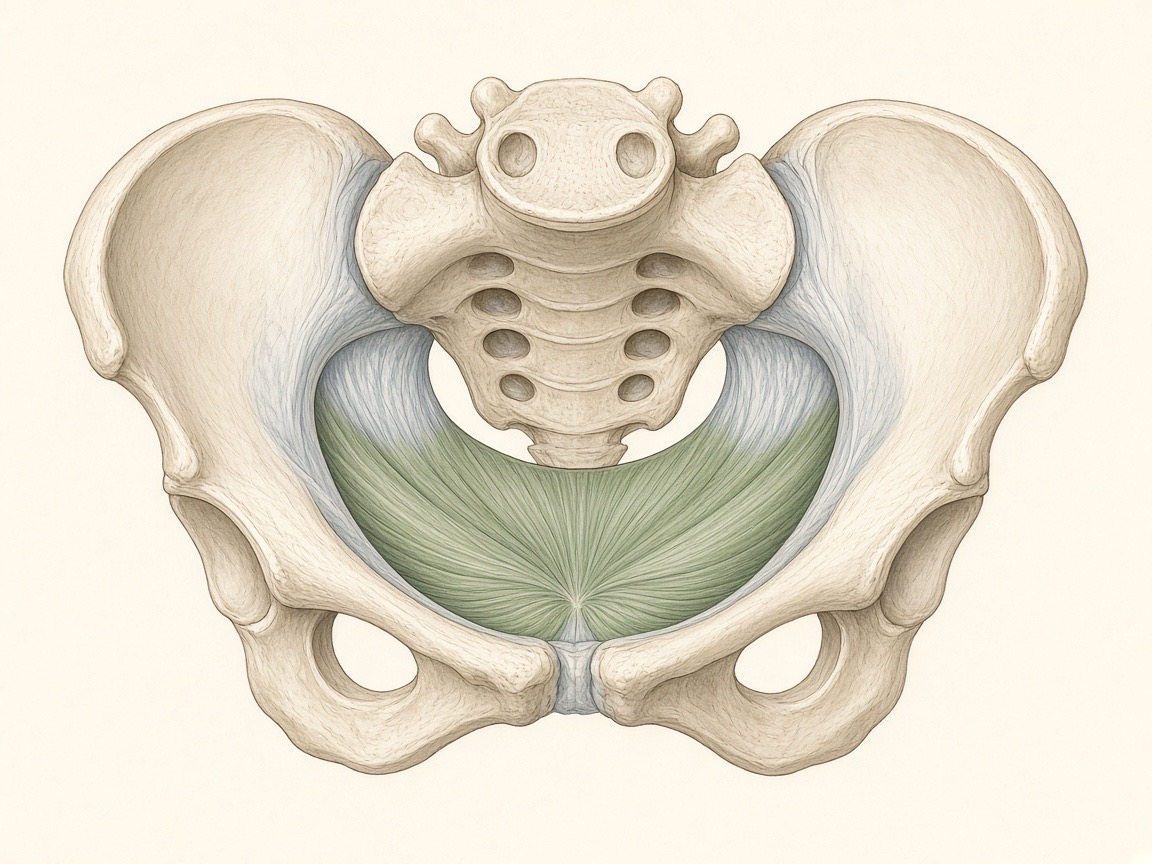
The three main jobs
These muscles do three different jobs at once, and we rarely notice.
They support. They carry the weight of the organs in the pelvis and redistribute it when we change position. That is why standing up from lying down does not feel like a special event.
They help closure. They contribute to the mechanism that maintains bladder and bowel control. That control is not fully voluntary. A large part runs automatically, with a reflex contraction that starts a fraction of a second before a cough or a sneeze.
They help stability. Together with the diaphragm, the deep abdominal muscles and the lumbar muscles, they form what is often called the core. When you lift a load, those four elements switch on together to steady the trunk. A pelvic floor that is not doing its share weakens the whole system, even if the symptom shows up somewhere else.
The link with breathing
The diaphragm and the pelvic floor move as a pair, like two parallel membranes that bound the abdominal cavity. On an inhale the diaphragm drops, pressure inside rises, and the pelvic floor gives slightly downward. On an exhale the opposite happens: the diaphragm rises and the pelvic muscles return upward.
That has a practical consequence. If you do the exercises while holding your breath, you work against your own diaphragm and raise abdominal pressure in the wrong direction. It is the most common mistake. We come back to it on the Exercises page.
Tone, not only strength
Calling a muscle “weak” is a simplification. A muscle can work poorly in two opposite ways: it cannot contract hard enough, or it stays tight and cannot let go.
The second case is less intuitive, but it is not rare, and in men it is often missed. A muscle that stays clenched — through ongoing stress, posture, or the habit of bracing the abdomen — fatigues, loses elasticity and can bother the pelvic or lumbar region. In that situation, adding more contraction exercises makes things worse. What is needed is the opposite: learning to release.
Why tone fades
There is no single cause. In most cases several factors add up over years.
- Age. Like other skeletal muscle, this one loses mass and speed, especially if it is not used.
- Too little movement. Long hours of sitting reduce spontaneous core activation and change how the pelvis is supported.
- Body weight. More abdominal fat raises the pressure that sits on the structure all day. A sustained change in weight is a matter for your GP or a registered dietitian, not for a piece of equipment.
- Repeated strain. Lifting while holding the breath, a chronic cough, or habitual straining on the toilet load the same region again and again.
- Surgery in the pelvic region. After an operation, muscle rehabilitation is often part of recovery. The clinical team decides the type and the timing.
- High-intensity training without stability work, which repeatedly drives pressure downward.
The useful fact: it is muscle
Physiologically the pelvic floor is striated muscle, the same category as the biceps or the quadriceps. It responds to training on the same principles: progressive load, regularity and recovery. It is not tissue that wears out in a way that cannot change.
The work can have real effects, but it asks for the same things as any other training: weeks, not days. International guidance on pelvic floor training usually suggests at least three months before you judge the result.
Changes you should not ignore
Some situations deserve a clinical assessment rather than a solo plan:
- Leakage of urine, even a small amount, with effort or a sneeze
- A sudden urge that is hard to delay
- A feeling of incomplete emptying
- Ongoing pain or tightness in the pelvis, groin or lower back
- Any change that appeared quickly and without an obvious reason
None of these points, on its own, supports a conclusion, and that is not the purpose of an information page. They are reasons to book an appointment, nothing more. There is more in the Men's health section.
In short
- The pelvic floor is a muscular hammock at the base of the pelvis. Men have one, and it can be trained.
- It supports organs, contributes to continence, and steadies the trunk together with the diaphragm and the deep abdominal muscles.
- It moves with every breath. Working while holding the breath works against you.
- It can function poorly from weakness or from too much tension. The approaches are opposite.
- As striated muscle it responds to training, but over weeks and months.